Danny Ford Net Worth 2026: Clemson Era To Now
Danny Ford Net Worth is shaped by his Clemson championship run and Arkansas years. See what is confirmed about his finances and career earnings.
Apr 02, 20264.3K Shares187.4K Views

Danny Lee Ford was born on April 2, 1948, in Gadsden, Alabama. He is the son of Norris and Lou Etta Ford. Ford grew up in Gadsden in a working-class family; his father, Norris, worked at the local Goodyear tire factory for over 39 years, and young Danny often worked there during summer breaks.
His early years were spent in Gadsden, and later he moved with his family to Tuscaloosa, Alabama. Ford graduated from Gadsden High School in 1966. He then attended the University of Alabama in Tuscaloosa, earning a bachelor’s degree in industrial arts in 1969 and a master’s degree in special education in 1971.
| Fact | Detail |
| Full Name | Danny Lee Ford |
| Birth Date | April 2, 1948 |
| Birthplace | Gadsden, Alabama |
| Danny Ford Net Worth 2026 | Not publicly disclosed |
| Profession | Former football coach |
| Education | University of Alabama graduate |
| Playing Role | Offensive lineman |
| Coaching Record | 122–59–5 |
| Key Achievement | 1981 National Champion (Clemson) |
| Honors | Hall of Fame (2017) |
| Current Life | Retired farmer in South Carolina |

Danny Ford Career
Danny Ford is a retired American college football player and coach best known for his tenure as head coach at Clemson University and the University of Arkansas.
A native of Alabama, Ford played at the University of Alabama from 1967 to 1969 and later transitioned into coaching. He served as Clemson’s head coach from 1978 through 1989 and compiled an overall college coaching record of 122–59–5.
At Clemson, his teams won five Atlantic Coast Conference (ACC) titles and six bowl games. In 1981 Ford guided Clemson to a perfect 12–0 season and the Orange Bowl victory over Nebraska, earning the program’s first ever national championship.
After Clemson, Ford was head coach at Arkansas from 1993 to 1997, where he led the Razorbacks to the SEC West Division championship in 1995. His success at both schools earned him induction into the College Football Hall of Fame in 2017.
College Playing Career At Alabama
Ford was a standout lineman at the University of Alabama under legendary coach Bear Bryant. He played at Alabama from 1967 to 1969, primarily as an offensive lineman, and was recognized for his performance on and off the field.
He earned first-team All-SEC honors and served as a team captain in his senior year. Ford’s tenure as a player included appearances in three bowl games, reflecting Alabama’s strong teams during that era. His success at Alabama set the stage for a seamless move into coaching after graduation.
Transition From Player To Football Coach
After completing his college degrees in 1970–71, Ford immediately began a coaching career. He first returned to his alma mater as a graduate assistant and offensive line coach on Alabama’s staff, learning under Bear Bryant.
In the mid-1970s he was an assistant coach at Virginia Tech. In 1977 he joined Clemson’s staff as an offensive line coach under head coach Charley Pell.
When Pell abruptly left Clemson after the 1978 regular season, the 30-year-old Ford was promoted to head coach for the final game of the year. This marked the beginning of his head coaching career in college football at Clemson.
Clemson Coaching Career And National Championship Success
At Clemson, Ford quickly revitalized the program. In his first season as head coach (1978), he led the Tigers to a Gator Bowl victory over Ohio State.
The program’s fortunes continued to improve over the next few years. In 1981, Ford’s squad went 12–0, including wins over highly ranked Georgia and North Carolina during the regular season and a decisive win against Nebraska in the Orange Bowl.
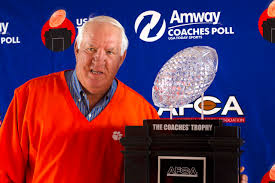
That perfect season earned Clemson its first national championship in any sport. Ford was honored as the AFCA National Coach of the Year and the Eddie Robinson National Coach of the Year for 1981.
During his 12-year tenure at Clemson, Ford’s teams never had a losing season and routinely competed at a high level. He coached Clemson to five ACC titles (1981, 1982, 1986, 1987, 1988) and captured two ACC Coach of the Year awards in that span.
Clemson won six of eight bowl games under Ford, and the program achieved a then-school-record 41 consecutive weeks ranked in the AP Top 25. By the time Ford left Clemson after the 1989 season, his record at the school stood at 96–29–4, a .760 winning percentage.
This remains the highest winning percentage in Clemson history among multi-year coaches, and his 96 wins are second only to legendary coach Frank Howard at Clemson.
Coaching Career Highlights, Records, And Achievements
Over his entire coaching career, Ford built an impressive list of accomplishments. His overall record was 122–59–5.
In addition to Clemson’s success, his Arkansas team in 1995 won the SEC Western Division, the Razorbacks’ first division title. Ford’s squads produced numerous top players: he coached 15 first-team All-Americans and 73 first-team all-conference players during his head coaching tenure.
Clemson was consistently nationally ranked under Ford, and his teams finished each season among the ACC’s elite. Ford and his players earned many individual awards. In 1981 he was named National Coach of the Year by both the American Football Coaches Association and the Football Writers Association (Eddie Robinson Award).
He was twice chosen ACC Coach of the Year during his Clemson tenure. At Clemson, Ford coached three ACC Players of the Year and multiple rookies of the year. He also developed a program in which 21 players earned Academic All-ACC honors. For his contributions, Clemson honored Ford by inducting him into the school’s Ring of Honor in 2013, and he was enshrined in the College Football Hall of Fame in 2017.
Coaching Style, Leadership, And Impact On College Football
Danny Ford’s coaching style reflected the tough, disciplined approach he learned under Bear Bryant. As a former Alabama assistant, Ford emphasized strong line play, physical conditioning, and attention to fundamentals.
His leadership changed the culture at Clemson: he instilled confidence and accountability, leading to sustained success. By winning the national championship, Ford put Clemson football on the national map and helped establish the program’s tradition of excellence.
His impact is underscored by the fact that he never had a losing season at Clemson and that his 1981 championship remains a celebrated milestone in the school’s history.
In recognition of his achievements and character, Ford has been honored with multiple Hall of Fame inductions. Clemson celebrated his legacy by placing him in the program’s Ring of Honor.
His 2017 induction into the College Football Hall of Fame reflects the high regard with which he is held in the college football community. Today Ford is remembered as one of the most successful coaches in Clemson history and a key figure who helped shape the trajectory of college football in the Southeast.
Danny Ford Net Worth
As of 2026, Danny Ford's net worth has not been publicly disclosed, and no figures have been officially verified by major financial authorities. He earned income during his career as a college football coach, serving as head coach at Clemson University (1978–1989) and the University of Arkansas (1993–1997), although details of his contracts and salary have not been made public.
In retirement, Ford and his family manage a 174-acre farm in upstate South Carolina, where they raise cattle and have experimented with crops such as hemp. Ford has described this work as a personal hobby rather than a business, noting at age 75 that he is “not doing it for a living.” Specific earnings from his coaching career or agricultural activities have not been disclosed, and no other verified sources of income are publicly documented.
FAQs
1. Who Is Danny Ford?
Danny Ford is a former American college football player and coach. He is best known for leading Clemson University to a national championship in 1981.
2. When Did Danny Ford Coach At Clemson?
Danny Ford served as head coach at Clemson from 1978 to 1989. During this period, he established one of the most successful eras in the program’s history.
3. What Teams Did Danny Ford Coach?
Danny Ford was head coach at Clemson University and later at the University of Arkansas. He also held assistant coaching roles earlier in his career.
4. What Is Danny Ford’s Connection To Alabama?
Danny Ford attended and played football at the University of Alabama. He later began his coaching career there as a graduate assistant.
5. What Honors Has Danny Ford Received?
Danny Ford was inducted into the College Football Hall of Fame in 2017. He also received National Coach of the Year honors in 1981.
Latest Articles
Popular Articles